The hearing nobody remembers watching
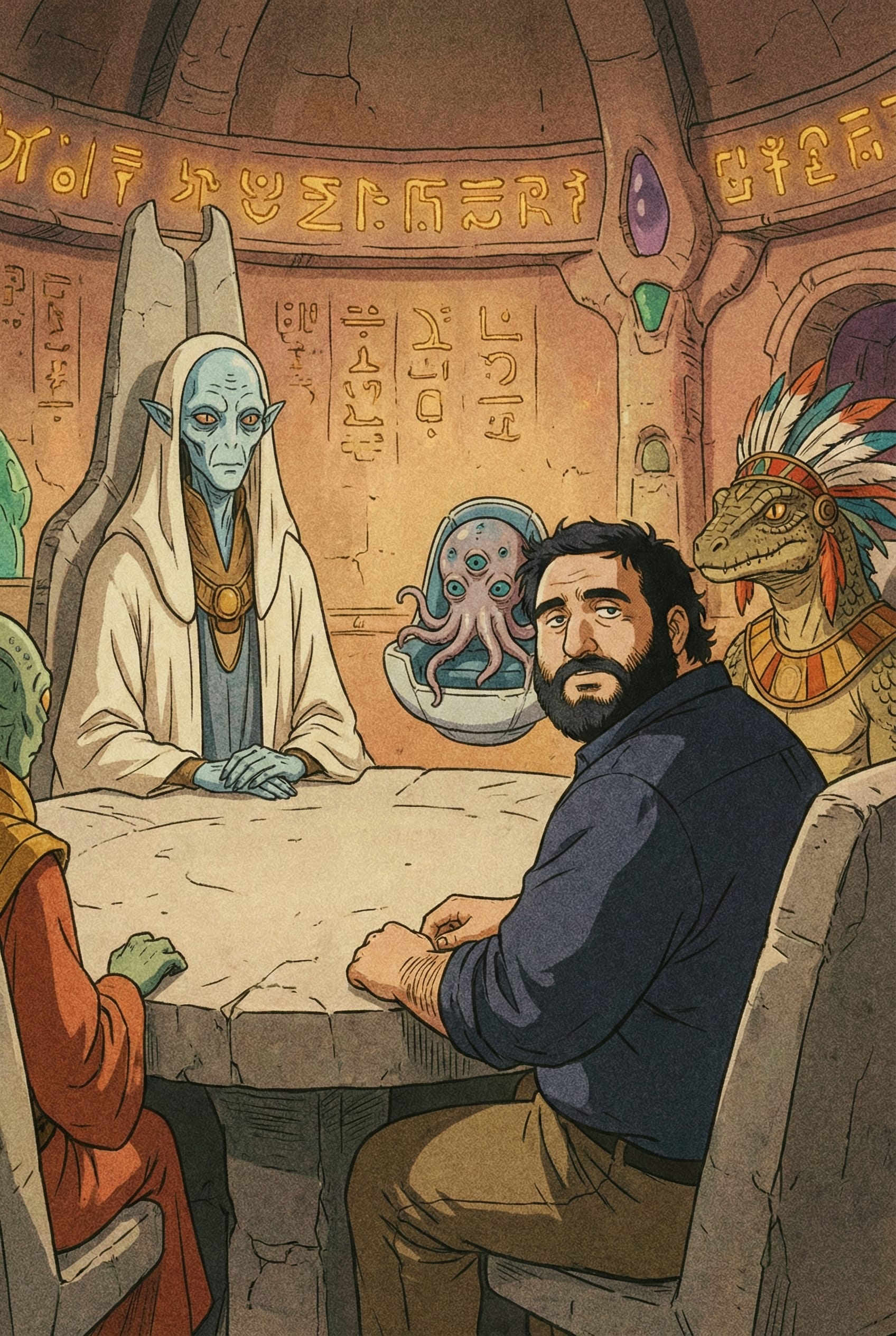
On July 26, 2023, a former intelligence officer sat in front of the U.S. Congress and said, under oath, that the American government has been running a secret program to recover and reverse-engineer vehicles of non-human origin.
His name is David Grusch. He spent 14 years in Air Force intelligence. He co-led the analysis of unidentified anomalous phenomena at the National Geospatial Intelligence Agency. He filed a formal whistleblower complaint through official channels.
And he said, on camera, in a room full of elected representatives from both parties, that "non-human biologics" had been recovered from crash sites.
I watched that hearing from Dubai. Something is off. Everyone can feel it. Nobody wants to name it.
The next day, my feed was back to AI valuations and SaaS metrics.
Nobody cared.
I don't mean nobody reported on it. CNN ran a segment. NPR covered it. But the story died in 48 hours. No sustained investigation. No public pressure. No serious journalist working full-time on what would be, if true, the biggest story in human history.
Grusch wasn't alone. A former Navy fighter pilot named Ryan Graves testified that encounters with unidentified objects off the coast of Virginia were "not rare or isolated." Commander David Fravor described tracking an object that moved in ways no known aircraft can. These are not YouTubers. These are people who flew F-18s for the United States military.
Then in November 2024, Congress did it again. Another hearing. Luis Elizondo, a former Department of Defense official, said under oath that advanced technologies "not made by any government" are monitoring military installations. A journalist named Michael Shellenberger entered a 214-page report and a 12-page document into the congressional record describing something called "Immaculate Constellation," a secret UAP data retrieval program.
Representative Nancy Mace joked that even saying the name out loud might get her a FISA warrant. "So come at me, bro, I guess," she said.
Bipartisan. Bicameral. Sworn testimony. Documents in the record.
And again: nothing.
I've spent my career around systems that look one way from the outside and work completely differently on the inside. That's what venture capital taught me. That's what venture backing taught me. You sit across from a founder, and sometimes the pitch is clean, the deck is polished, and underneath it all, the company is already dead. Other times, a mess of a person with a mess of a plan is sitting on something real.
The skill isn't spotting the clean pitch. The skill is spotting the gap between what's presented and what's actually going on.
I see a gap here. A big one.
I'm not going to tell you aliens exist. I don't know that. But there's a question underneath the UFO circus that I find far more interesting, and far more disturbing: what happened to fundamental physics?
When I started looking into the UAP story, I expected to find conspiracy theories, I found a paper trail.
In November 1969, the United States Congress passed the Mansfield Amendment. Section 203 of Public Law 91-121. It said the Department of Defense could no longer fund basic research in universities unless that research had "a direct and apparent relationship to a specific military function."
The context was Vietnam. Anti-war protests on campuses. The Pentagon funding professors felt wrong to people. Senator Mansfield argued that defense money shouldn't subsidize pure scientific curiosity. That was a civilian agency's job.
It sounded like a peace measure. Here's what it actually did.
From 1945 to 1969, the DoD was the primary funder of open-ended basic research in American universities. Physics, mathematics, materials science, early computing. The Office of Naval Research, ARPA, Air Force research offices. They gave money to brilliant people and let them follow their curiosity. That's how quantum field theory got funded. That's how early computing happened. Hundreds of millions of dollars a year, with almost no strings attached.
After 1969, that pipeline closed. The amendment pushed research toward short-term applied work. The National Science Foundation was supposed to pick up the slack but didn't have the budget. And the sensitive work, the stuff with strategic implications, migrated behind classified walls. National laboratories. Aerospace contractors. Think tanks. Places like the Draper Lab at MIT, Lincoln Lab, Johns Hopkins Applied Physics Lab.
I know this pattern. I've seen it in business. When a company says it's "restructuring for efficiency," it's usually concentrating power and killing the things it can't control. The Mansfield Amendment did that to American science. It took independent researchers out of the most important work and replaced them with employees who needed clearances and couldn't publish.
The people who noticed at the time were the ones who always notice: the ones who refused to stay quiet. Linus Pauling had his passport confiscated because his activism made him inconvenient, and this was a two-time Nobel Prize winner. Grothendieck, probably the most important mathematician of the 20th century, eventually walked away from institutional science entirely. These weren't marginal figures. These were the best. And the system found ways to push them aside.
Then something else happened. Over the following decades, academic science developed layers of control that, individually, each seem reasonable. Taken together, they form a system that's very hard for a new idea to survive.
I see this in entrepreneurship too. A startup trying to get funded faces gatekeepers at every step: the warm intro, the partner meeting, the term sheet, the board seat. Each step filters. And the people who make it through tend to look the same, think the same, build the same things. That's how you end up with 500 identical SaaS companies and zero bold bets.
Physics got its own version of this. Peer review became the only way to validate ideas. A handful of publishers controlled distribution. Citation metrics decided careers. And in theoretical physics specifically, one framework dominated everything for decades. If you wanted a professorship, you worked inside that framework. If you didn't, you were out.
I don't blame the framework itself. The problem is monopoly. In venture, when one investor controls a market, founders get worse deals and fewer choices. In science, when one paradigm controls all the funding, all the journals, all the hiring committees, you don't get breakthroughs. You get incremental papers that cite each other.
Fifty years of that.
Here's where I start connecting dots that I'm not sure I should connect. But I'm going to, because I've learned that the interesting truths are usually in the places you're not supposed to look.
This week, literally right now as I write this, New Mexico just passed a bill to create a "truth commission" investigating Jeffrey Epstein's Zorro Ranch, a 7,500-acre property near Santa Fe. The FBI never searched it. Federal investigations focused on the island and the New York townhouse. New Mexico got ignored.
Epstein himself said in a 2019 interview that he bought property in New Mexico because he learned that scientists who had worked at Los Alamos were doing private research nearby, at places like the Santa Fe Institute. He funded Murray Gell-Mann, the Nobel Prize-winning physicist who coined the word "quark." He met with MIT and Harvard professors at the ranch. Kissinger Associates sent people there.
The public story about Epstein is about sex trafficking and powerful men. That's real and horrific.
But there's a parallel story that almost nobody covers. Epstein was systematically building relationships with physicists and mathematicians. He was funding their work. He was putting them in situations where they could be compromised. And his ranch sat 50 miles from Los Alamos, 111 miles from the Trinity test site, and in the same state as Sandia National Laboratories.
I'm Lebanese. I grew up around people who understood that when powerful interests want to control something, they don't use force first. They use money, access, and information asymmetry. They create dependency. They build networks that look like philanthropy and function like intelligence operations.
The Epstein science network looks exactly like that to me.
So let me state what I actually think.
I don't think the U.S. government has a complete theory of everything locked in a safe. I don't think there's a clean answer behind any of this. What I think is that fundamental physics was deliberately constrained starting in 1969, that some research continued behind classified walls, and that we don't know what came out of it. Maybe very little. Maybe something.
I think Epstein's interest in scientists wasn't random philanthropy. Someone was trying to map what the physics community knew and didn't know. Whether that's a government, a private group, or something else entirely, I can't say.
And I think the congressional hearings matter more than people realize. When military and intelligence officers go under oath and say that technologies of non-human origin exist, and that programs to study them have been hidden from Congress, that's either perjury or it's real. There's no comfortable middle ground.
What I know for sure is the reaction. I've been watching it for two years now. The collective shrug. The way people hear the testimony, nod, and then go back to their phones. I've seen this exact pattern in boardrooms. It's what happens when a truth is too expensive to process. When the implications would require you to rethink too many things at once, the brain just... files it away.
But the implications don't go away because you ignore them. They compound.
I've built and broken enough things to know that the gap between what's said in public and what's happening behind the scenes is where the real story always lives.
I don't have the real story. Nobody outside a very small number of people does.
But I know the gap is there. And it's bigger than people think.
No spam, no sharing to third party. Only you and me.